September 8, 2026, 2:35 pm

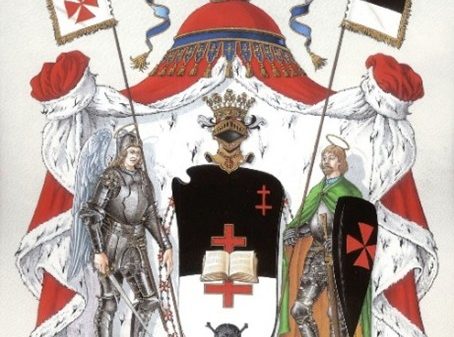

EUROPE, WHERE ARE YOU GOING!
By Don Francesco Alfredo Maria Mariano
To speak of Chivalry and nobility in an era when even their memory has been lost, in times when every ideal is inexorably overwhelmed and bent to the most hedonistic satisfactions of life, is an undertaking that is not only highly arduous, but perhaps to some, strange and anachronistic.
Everything progresses dizzyingly through inventions and discoveries, while in the field of ideal values man, turning his gaze toward the conquest of the immensity of the skies, completely neglects the path of “nosce te ipsum” (“know thyself”) and that of a closer investigation into the vast, unexplored world of the human soul.
It must be stated, however, that even today, while absurd theories of human leveling assert themselves and the space available to homo spiritualis is inexorably reduced, a Chivalry continues to exist that does not die and can never fade away: it is the Chivalry of the Spirit, which is substantiated and perpetually blossoms in an ideal of justice and beauty—so exquisite and rare that it morphs, almost, into a dream-like ideal, yet one that retains its peculiar social function even in this end of the millennium.
Even though times have changed and certain metamorphoses have become logical and necessary, the ancient ideals maintain their validity and relevance, managing to perpetuate themselves as the expression of a profound ethical system.
Modern Knights, who do not differ much from those of antiquity, share the same mission, the same noble heritage to carry in their blood and hearts, and the same duty as of old to “lend an ear everywhere to catch cries for help.”
Everyone must fight for the reaffirmation of the perennial values of life and, through personal industriousness and dedication, continuously revitalize the torch of love, fraternity, friendship, justice, and peace—for these are the values, and they alone, that make life sacred and worth living.
The heritage received from our predecessors is not enough; continuity is also required—that is, continuing on the path of commitment, goodness, and valor so that this heritage does not exhaust itself, but survives, enriched by new lifeblood.
Chivalry was born with the rise of Feudalism which, by privileging primogeniture, left all the cadets of the feudal family—meaning the sons born after the firstborn—to fend for themselves.
These younger sons either resigned themselves to living under the authority of their older brother, embraced an ecclesiastical career, or fought in the service of some feudal lord. Even this last option was not simple: the road to becoming a professional warrior was long and hard: first training as a page until the age of fourteen, and then as a squire. Finally, around the age of twenty, he would receive his full armor: breastplate, helmet, sword, and golden spurs. During the investiture ceremony, the Feudal Lord would proclaim him a knight.
But these knights did not yet possess the characteristics of those who would later distinguish themselves in defending noble virtues. The Church thus intervened to provide a moral direction to their activities. In this way, an unhealthy and dangerous segment of that society was reshaped through a religious and charitable ideal.
Chivalry thus became a great force, an aristocracy of valor and gentleness, a bulwark against the tyrannical, a defense for the Church in the struggle against infidels, and the symbol of loyalty and honor. The code of honor of every knight exalted dedication to the weak and their needs against the injustices of the powerful, the defense of children, the protection of orphans and widows, the veneration of women, and the fight to safeguard the noblest ideals of faith.
Christianized Chivalry was one of the greatest triumphs of the Church, and proof of this lay in the great crusades, the ultimate expression of the chivalric ideal. In its blossoming and splendor, Chivalry was a body open to all, nobles and non-nobles alike, especially since from its origins it had been shaped by the principle that “the supreme reason for excellence, among all those who belonged to it, was not birth, but personal merit.”
Thus, all knights were equal to one another, including those of royal blood! Furthermore, chivalric dignity was a personal and non-transferable matter, though one Knight could dub another. The Church later transformed the investiture ceremony into a religious consecration, preceded by the vigil of arms; awaiting this second baptism, the investiture was accompanied by solemn religious ceremonies such as the blessing of weapons, Holy Communion, and the oath.
In fact, the aspiring knight would swear on the Gospels in public to the one granting him the investiture, promising to always be faithful to the Church and to the laws of honor, to behave courageously and loyally, to keep his word, not to betray his Lord, to fight for the Christian faith against infidels, to “right” wrongs, to avenge injustices, and to protect the oppressed, orphans, and widows.
Thus, from the 11th to the 14th century, Chivalry developed across Europe, especially in France, Spain, and Italy. Various Chivalric Orders arose, carrying everywhere, along with Faith in Christ, those new concepts of humanity and generosity from which a new social justice emerged. They fostered industries and commerce, founded hospitals and leprosariums, and left the mark of a new civilization that was simultaneously chivalric and Christian, writing pages of an immortal epic upon the fiery battlefields and across the bleeding seas of Lepanto.
Chivalry thus became a sort of religion, as appears from the ceremony of its “arming,” which was rich in liturgical and military practices. Similar to a consecrated person, the aspiring knight had to serve his novitiate as a “page”; then, just as a novice becomes a “cleric” and then a “priest,” so the page became a “postulant squire” and finally a “knight.”
And while the military rite was quite simple, consisting of the presentation of the sword and spurs, the religious rite was highly complex and deeply liturgical. The “bath” and the “white robe” of the postulant symbolized Baptism; the sackcloth he wore represented “penance” and “confession”; the piattata—that is, the tap of the sword on the shoulder—the accollata (the touching of the shoulder and the kiss on the left cheek), all occurring after the oath, signified confirmatio.
Finally, there was the priest’s blessing, the “sacred unction.” And this mystical rite did indeed create a spiritual kinship between the one who “armed the knight” and the one who was “armed.”
It was much like the cognatio spiritualis provided for in Confirmation by Canon Law, inter confirmatum et patrinum (between the confirmed and the godfather). To “arm a knight” was a high privilege of the knight himself, almost a sacramental chrism.
“I will not invade a church in any way. I will not attack a cleric or a monk unless they carry the weapons of the world […] I will not take their horse. I will not assault the peasant man or woman, nor the merchants; I will not take their horse; I will not ruin them by taking their money; I will not ruin them by taking their goods under the pretext of their lord’s war, and I will not beat them to deprive them of their livelihood. I will not burn down or tear down houses, unless I find an enemy knight or a thief inside them […] I will not attack noble women nor those traveling with them […]; I will behave in the same manner toward widows and nuns.”
These are just a few passages taken from the oath document of the medieval knight, reported in the book The Year One Thousand by the French medieval historian Georges Duby.
It would be interesting to list all the places, people, and assets that the knight swore to respect, shielding them from violence, with the exception of circumstances where self-defense was legitimately required—according to a principle of elementary and understandable common sense, of natural self-preservation when faced with an imminent threat.
A threat which, alas! Is repeating itself through a silent invasion masquerading as immigration, except for those poor souls fleeing from wars.
Thus, our traditions are once again in danger, our Europe is in danger, our children are in danger, as is our economy; our demographic growth is in danger, not to mention social order and discipline.
Unfortunately, the values that our ancestors achieved with such great effort, sometimes even with their blood, are crumbling, attempting to alter our generation for the worse.
Upon that code of values—based on the contempt for danger, the defense of faith, the protection of the weak, and the devotion to the beloved woman—rested the Knight’s sense of honor and the title itself, which could be revoked at any moment for an act of felony or cowardice.
The Knight, therefore, is not someone who flaunts just any cross, whether merited or not, but someone who succeeds in embodying the elevation and ethical refinement of life; one who stands as a true paladin of law and faith, of the weak and the oppressed, an enemy to all that is futile and vulgar.
A Knight is only one who carries in his blood, mind, and heart that yearning for loyalty, justice, generosity, and altruism for which Chivalry has been, is, and will be in all times and in any social system the forerunner of every noble action, at the service of one’s neighbor, but above all of God Our Lord. Whether “warrior” or “religious,” it always constitutes a noble institution instrumental to human evolution. Saints and Knights are the apostles of the spirit, and they often end up merging into a single militia. It is no coincidence that Saint Francis of Assisi called his poor friars “knights,” who in modesty and poverty stood to stem a century of luxury and corruption.
In our testimony, therefore, through Faith and example in a Truth that wants us strong, loyal, generous, and courageous in defending Christian principles, we must recognize the meaning of the insignia, the merit, and the value of Chivalric Orders and Associations:
an award for rectitude, to modern Knights, messengers of a new conception of international relations that are understood as a noble contest for the conquest of the highest ideals, in ever-living respect for one’s own and others’ culture.
Every Homeland is an expression of this, becoming the sacred guardian of its precious roots, without which every identity is erased, every historical event rendered vain, and its profound teaching lost. The greatest of all Evils is the loss of memory.
Hard is the path for us Europeans to ensure that the bond with our ancient Fathers is not lost and that Chaos does not prevail, but our patron Saints are always by our side to sustain us in this fight that only true knights can wage without losing heart! The supreme Celestial will will ensure that we find each other again and help one another in the defense of our august tradition and two-thousand-year-old civilization.
Already in the Middle Ages, the concept of the Homeland was well-rooted and took shape through attachment to the land, in the love of the territory. One need only think of the daring Joan of Arc, certain in her heart of the mission to be accomplished by divine appointment, who was placed alongside the commanders of the French army against the invaders.
But even prior to that, as another great French medievalist, Régine Pernoud, reminds us, back in the distant year of 1124, when the armies of Emperor Henry V attempted to invade France, a strong national sentiment blossomed everywhere, causing a general rush to arms throughout the kingdom.
Even the rebelling barons forgot their disputes to rally together under the royal banner, the famous red oriflamme bordered with green, which Louis VI had taken from the altar of Saint-Denis.
The emperor, after invading the county of Champagne and reaching Reims, caught off guard by such spontaneous and unified resistance, marched backward.
Let us never forget that without justice—the virtue par excellence—no peace is possible since, as Gandhi, the founder of the sacred principle of non-violent struggle, taught us, “no civilization can be considered as such if it seeks to prevail over others.” It is well known: the sun is closer to its rising the deeper the night is. Thus, the forces of the spirit, often mortified, strengthen within themselves their greatest energies for rebirth, precisely when “matter” seems to overwhelm every ideal of life.
This is why, in days like ours, when profit succeeds in clouding the moral world, we must lift our eyes toward the light, looking toward that “Knight’s banner”—luminous and bleeding from the suffering of martyrs and heroes—as a sun for the rebirth of ourselves and of all Humanity; but particularly today, more than ever, we must safeguard our Europe.
Feliciter and may God help us!
This day, VI/VI/MMXXVI
Don Francesco Alfredo Maria Mariano
𝐂𝐡𝐢𝐞𝐟 𝐄𝐝𝐢𝐭𝐨𝐫 :
𝐌𝐝. 𝐒𝐚𝐝𝐢𝐤𝐮𝐫 𝐑𝐚𝐡𝐦𝐚𝐧 𝐑𝐮𝐦𝐞𝐧